Training a frontier AI model isn’t some magical black box where you throw data at a GPU and hope for superintelligence. It’s a carefully orchestrated process that combines architecture design, massive computational resources, and methodologies that have evolved dramatically over the past few years. If you want to understand how models like GPT-4, Claude, or Gemini actually come to life, you need to understand what’s happening under the hood.
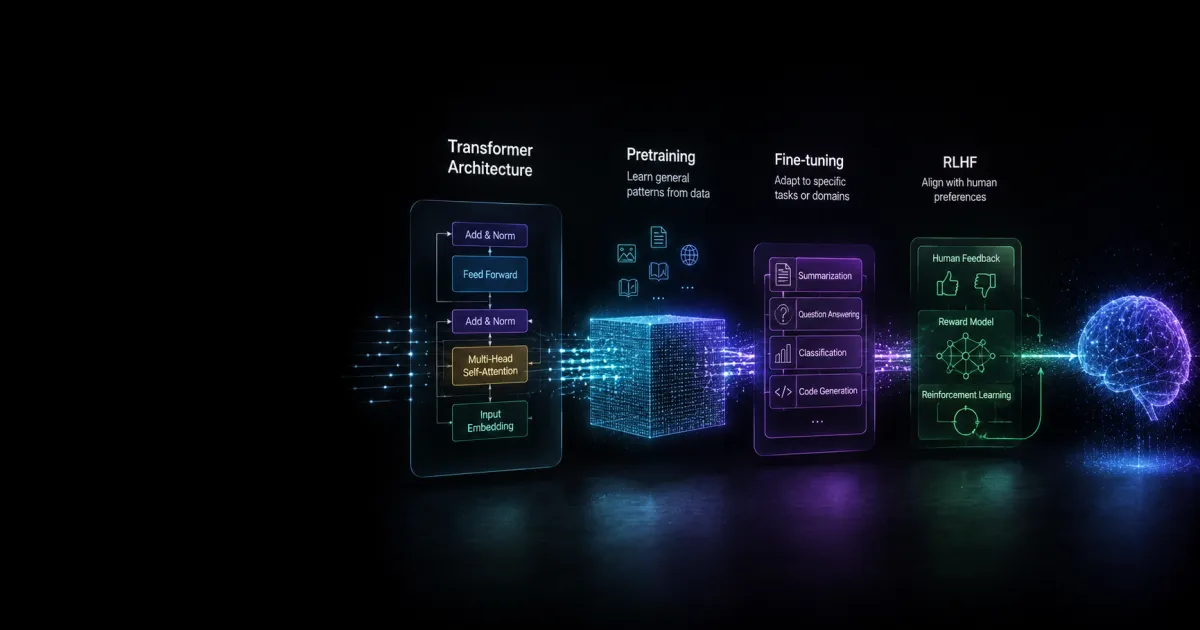
Frontier AI models are trained using a multi-stage pipeline that starts with transformer architecture, moves through massive-scale pretraining on diverse text data, and then gets refined through supervised fine-tuning and reinforcement learning from human feedback. The entire process involves billions of parameters, terabytes of data, and computational infrastructure that costs millions of dollars to run.
The Architecture Foundation – Transformers Rule Everything
Let’s get the obvious part out of the way: almost every frontier AI model today is built on the transformer architecture. This isn’t some accident or temporary trend – transformers fundamentally changed how we approach sequence modeling because they can process information in parallel instead of sequentially.
The key innovation is the attention mechanism. Instead of forcing the model to read text word-by-word in order, attention lets each token (a piece of text, roughly a word) look at every other token simultaneously and figure out which ones matter for understanding it. That’s why transformers scale so well – they’re not bottlenecked by sequential processing.
Attention mechanism – A neural network component that weighs the importance of different input elements when processing each output element, allowing the model to focus on relevant parts of the input.
Modern frontier models stack transformer layers on top of each other – sometimes 100+ layers deep. Each layer has multiple attention heads (think of them as different “focus patterns”), and they’re connected with feed-forward networks. The architecture is surprisingly simple when you break it down, but the scale is what makes it powerful.
Pretraining – Where the Real Learning Happens
This is where frontier models spend most of their computational budget. Pretraining takes massive amounts of text data – we’re talking hundreds of billions of tokens from the internet, books, code repositories, and other sources – and trains the model using next-token prediction.
The model learns by predicting what word comes next in a sequence. Billions of times. With billions of parameters adjusting to get better at this task. It sounds simple, but this process somehow teaches the model language structure, factual knowledge, reasoning patterns, and countless other capabilities it never explicitly learned.
The scale here is genuinely staggering. Frontier models train on datasets containing trillions of tokens. That’s not hyperbole – we’re talking about processing more text than exists in the entire public internet multiple times over. They use techniques like data deduplication and filtering to maximize quality, but the volume is still enormous.
Next-token prediction – The training objective where a model learns to predict the next word in a sequence given all previous words, forming the foundation of language model pretraining.
During pretraining, models use distributed training across thousands of GPUs or specialized AI accelerators. This requires careful orchestration – you need to split the data, synchronize gradients across machines, handle failures gracefully, and keep everything running efficiently. It’s a nightmare logistically, which is why only well-funded organizations can do this at frontier scale.
Fine-Tuning and RLHF – Making Models Actually Useful
Raw pretrained models are… weird. They’ll complete prompts in unpredictable ways because they were trained to predict the next token, not to follow instructions or have conversations. That’s where fine-tuning comes in.
Supervised fine-tuning (SFT) takes the pretrained model and continues training it on curated examples of good behavior. You give it prompt-response pairs where the response is what you actually want the model to do. This teaches it to follow instructions and produce more useful outputs. It’s much cheaper than pretraining – you’re only training for days or weeks, not months.
But here’s where it gets interesting: you can’t just label everything manually. So teams create synthetic data, use rule-based systems, and rely on human annotators for the most important examples. The quality of these examples directly impacts model quality, which is why frontier labs obsess over annotation standards.
Then comes reinforcement learning from human feedback (RLHF). Instead of giving the model a single “correct” answer, you generate multiple responses and have humans rank them. The model learns to generate responses that humans prefer. This is how you get models that are actually helpful, harmless, and honest instead of just statistically coherent.
RLHF (Reinforcement Learning from Human Feedback) – A training technique where models learn to optimize for human preferences by generating multiple outputs, collecting human rankings, and adjusting the model to favor preferred responses.
The RLHF process uses a reward model – a separate neural network trained to predict which responses humans would prefer. The main model then optimizes against this reward signal using reinforcement learning algorithms like PPO (Proximal Policy Optimization). It’s complex, but it’s also why modern models feel more like assistants than autocomplete on steroids.
Data Strategy – Quality Over Quantity, Sort Of
You’d think that with trillions of tokens, frontier labs would just throw everything at the problem. They don’t, exactly. There’s a real emphasis on data quality because training on garbage produces garbage models.
Frontier labs use sophisticated filtering pipelines. They remove duplicates, filter out low-quality text, remove personally identifiable information, and apply various heuristics to keep only the most useful training data. Some organizations even train smaller models to classify text quality and use those predictions to weight the training data.
The composition of training data matters too. Models trained on too much code behave differently than models trained on mostly natural language. The ratio of different domains affects what the model is good at. This is why frontier labs carefully curate their data mixtures – it’s not random, it’s deliberate.
There’s also the question of copyright and licensing. Frontier labs train on publicly available internet data, which raises legitimate questions about whether they should be compensating creators. This is still an unsolved problem that’ll probably end up in courts.
Scaling Laws – The Weird Part That Actually Works
Here’s something that surprised everyone: model performance improves predictably as you scale up parameters, data, and compute. There are actual mathematical relationships between these factors and model quality. Researchers can predict in advance roughly how good a model will be based on how much you’re willing to spend.
This is called a scaling law, and it’s held up remarkably well. The formula is roughly: Loss = a * (N^-alpha) * (D^-beta), where N is parameters, D is data, and alpha and beta are constants around 0.07. It means you get diminishing returns as you scale, but improvement is still predictable.
This predictability is why frontier labs can plan their models in advance. They know roughly how much compute they need to hit a performance target. It’s also why compute has become the primary constraint – if you have enough compute and data, you can train a capable model. The limiting factor is usually money and electricity.
Inference Optimization – The Practical Problem Nobody Talks About
Training is expensive, but running these models is its own nightmare. A frontier model with 70 billion parameters needs serious hardware just to generate a single response. This is why you see techniques like quantization (using lower precision numbers), distillation (training smaller models to mimic larger ones), and various clever inference optimizations.
Latency matters too. Users don’t want to wait 30 seconds for a response. So labs optimize for throughput and speed, using batching, caching, and custom inference kernels. This is where the real engineering complexity lives – making these massive models actually usable in production.
Common Questions About Frontier Model Training
How long does it actually take to train a frontier model?
Pretraining typically takes 1-3 months on a large cluster. Fine-tuning and RLHF add weeks. But this varies wildly based on model size and computational resources. A larger model with more data takes longer, but if you have more GPUs, you parallelize better and finish faster. The total wall-clock time is usually measured in weeks to a few months, not years.
Why do frontier labs keep training bigger models if scaling laws show diminishing returns?
Because even diminishing returns are still returns. A 10% improvement in capability can be worth millions of dollars if your model is used at scale. Plus, there are capabilities that seem to emerge only at larger scales – things like in-context learning and chain-of-thought reasoning get noticeably better as models grow.
Can you train a frontier model without massive compute resources?
Not really at frontier scale. You can train capable models with less compute, but you’ll hit a ceiling. The frontier is defined by having enough resources to push the scaling laws to their limit. That said, techniques like mixture-of-experts and sparse models might eventually make this more accessible.
What’s the actual cost to train a frontier model?
Estimates vary wildly, but we’re talking tens of millions of dollars for the most capable models. Training compute costs, data acquisition, infrastructure, and the human expertise required to do this well all add up. This is why only a handful of organizations can afford to push the frontier.
How much of training is actually the transformer architecture versus everything else?
The architecture is maybe 20% of the problem. The rest is data quality, training methodology, optimization techniques, and sheer computational scale. You could use a slightly different architecture and get similar results if you got everything else right. The transformer is good, but it’s not magic – it’s the execution that matters.
Final Thoughts
Frontier AI model training is engineering at scale – taking well-understood techniques and pushing them to their limits with massive data, compute, and careful optimization. There’s no secret sauce, just ruthless execution, tons of money, and a willingness to iterate when things don’t work. The next frontier probably involves making this process more efficient because we’re hitting practical limits on electricity and cooling capacity.