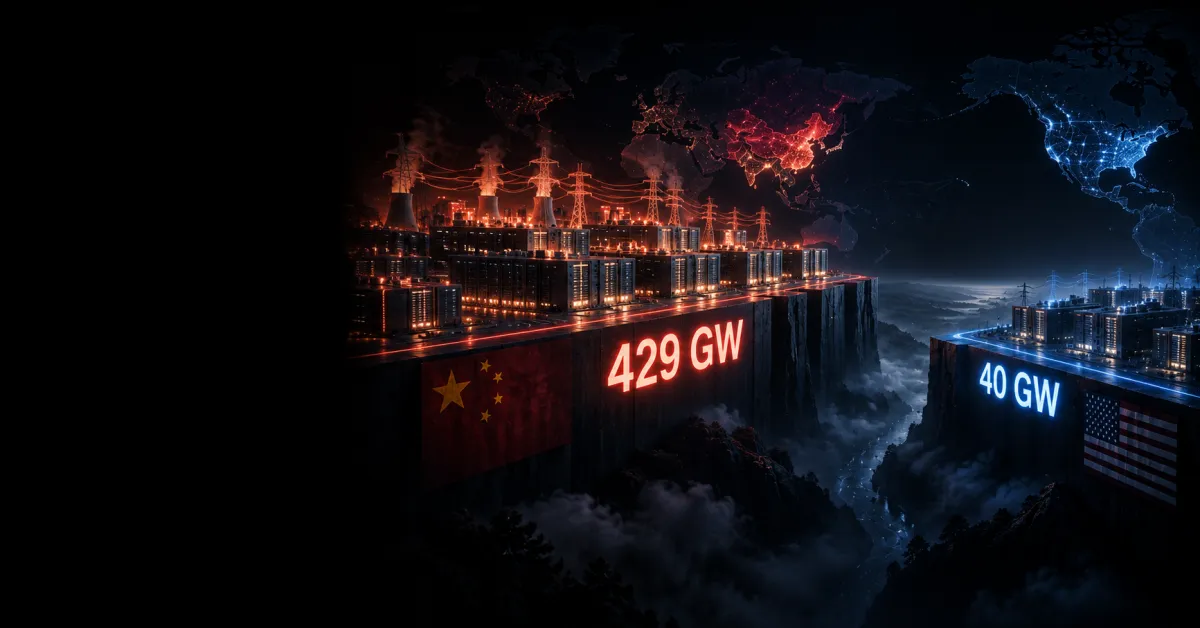
China just added 429 gigawatts of power capacity last year. The United States? 40 gigawatts. That’s roughly a 10-to-1 ratio, and if you’re wondering whether this matters for AI dominance, the answer is yes – it matters a lot more than most people realize.
Here’s what’s actually happening: China is building energy infrastructure at a pace that lets it power data centers, train massive AI models, and scale compute resources without hitting the electrical grid like a breaker switch. The US is moving slower on capacity expansion, which creates a genuine bottleneck for AI development and deployment. Energy isn’t sexy to talk about, but it’s the unglamorous foundation that determines who gets to run the biggest AI experiments and who has to make do with less.
Why Energy Capacity Matters for AI More Than You’d Think
Training a single large language model can consume as much electricity as a small town uses in a year. Running inference at scale – that’s processing billions of user requests through AI models daily – demands constant, massive power draws. Data centers housing GPUs and specialized AI chips aren’t optional luxuries. They’re the literal hardware that makes modern AI work.
When China adds 429 gigawatts annually, it’s not just a number on a spreadsheet. It means new data centers can be built without waiting for grid upgrades. It means companies can expand their AI infrastructure without negotiating with utility companies for years. It means the country can pursue aggressive AI scaling strategies without energy constraints holding them back.
The US adding 40 gigawatts is solid growth, but it’s not keeping pace with demand. Tech companies are already reporting energy bottlenecks. Data center construction is hitting walls because grid capacity in key regions – California, Virginia, Texas – can’t support the influx of new facilities. That’s not a minor inconvenience. It’s a structural limitation on how fast American companies can innovate.
The Infrastructure Gap – What 10-to-1 Actually Looks Like
Let’s be concrete about what this capacity difference translates to in practice:
- Data center expansion speed – China can build and power new facilities faster, reducing time-to-deployment for AI applications
- Model training capability – More available power means more GPU clusters running simultaneously, accelerating research and development cycles
- Inference scale – Serving AI models to millions of users requires sustained, reliable power. Capacity constraints force American companies to make tradeoffs on model size or user volume
- Redundancy and reliability – Excess capacity gives you breathing room. Tight capacity margins mean less flexibility when demand spikes
- Cost efficiency – Abundant power keeps electricity prices lower, reducing operational expenses for compute-heavy workloads
This isn’t about China having better technology or smarter engineers. It’s about having the physical infrastructure to actually execute at scale. Energy is the raw material of AI. Whoever has more of it available gets to move faster.
China’s Energy Strategy – Building for AI Dominance
China’s capacity additions aren’t random. A significant portion comes from renewable sources – solar and wind farms that can be built in remote regions and connected to data centers strategically. The country has also invested heavily in coal and nuclear capacity, creating a diverse energy portfolio that supports consistent, baseload power for data centers.
More importantly, China’s centralized planning allows rapid deployment. When the government decides a region needs energy infrastructure for tech development, the bureaucratic friction is lower. Land acquisition, permitting, and construction move faster than they typically do in the US, where environmental reviews, local opposition, and regulatory complexity can delay projects by years.
The Chinese government also directly funds data center buildouts in strategic regions, treating AI infrastructure as a national priority. This isn’t unique to China – the US government is increasing support for semiconductor and AI infrastructure – but China’s existing advantage in energy capacity gives it a head start.
What’s Holding Back US Energy Expansion
The American situation is more complicated. The US does have significant capacity additions happening, but they’re concentrated in specific regions and facing real constraints:
Grid modernization bottlenecks – Adding generation capacity is only half the problem. You also need transmission infrastructure to move that power where it’s needed. Many US grid upgrades are stuck in planning or construction phases that take 5-10 years.
Environmental and regulatory hurdles – Every new power plant or transmission line faces environmental impact assessments, public hearings, and regulatory approval. This is actually good for environmental protection, but it slows deployment significantly.
Renewable intermittency – A lot of new US capacity comes from solar and wind, which are great for sustainability but require battery storage or backup capacity to support 24/7 data center operations. That adds complexity and cost.
Competing demand – US power capacity isn’t just for data centers. It’s also serving growing EV charging needs, industrial demand, and residential consumption. The pie is being carved into more pieces.
None of these are unsolvable problems. But they create friction that slows the pace of expansion relative to China’s more streamlined approach.
The AI Training and Inference Implications
Here’s where the energy gap directly impacts AI development:
Training frontier models – The companies pushing AI capabilities forward (whether in China or the US) need massive compute clusters. More available power means more GPUs running in parallel, which means faster training cycles. Faster training cycles mean more experimentation, more iteration, and potentially better models. China’s energy advantage gives its AI companies literal speed advantages in the race to build larger, more capable models.
Running inference at scale – Once a model is trained, serving it to users requires consistent power. If you’re running an AI chatbot for millions of users, you need reliable, abundant electricity. Energy constraints force companies to make painful choices – limit users, use smaller models, or accept higher latency. China’s capacity advantage removes these constraints.
Experimentation velocity – The teams that can run the most experiments win. More power means more parallel compute, which means more hypotheses tested simultaneously. This compounds over time. The team that can run 10 experiments in parallel while competitors run 2 will innovate faster.
Is This Actually Decisive for AI Dominance
Energy capacity is necessary but not sufficient. The US still has advantages in talent, capital, and institutional knowledge around AI. American universities produce world-class AI researchers. US venture capital funds ambitious startups. Open-source communities centered in the US drive innovation that everyone benefits from.
But energy is a real constraint that’s becoming harder to ignore. If American companies can’t build data centers fast enough because of energy bottlenecks, those advantages in talent and capital start to matter less. You can’t run experiments if you don’t have the power to run them.
The honest take: China’s energy infrastructure advantage is significant and growing. It’s not the only factor determining AI dominance, but it’s a material one. The US can still win the AI race, but it requires taking energy infrastructure seriously – actually accelerating permitting, investing in grid modernization, and treating data center power supply as a strategic priority, not an afterthought.
FAQ – Energy, Infrastructure, and AI
How much power does training a large language model actually use?
Training models like GPT-4 scale can consume 10-50+ megawatts continuously over weeks or months. That’s roughly equivalent to what a small city uses. The exact number depends on model size, hardware efficiency, and training duration, but the scale is enormous.
Can the US catch up on energy capacity quickly?
Not overnight, but yes over the next 5-10 years if it prioritizes it. The US has the technology, capital, and resources. The bottleneck is regulatory and political will, not technical capability. Streamlining permitting for data center infrastructure would help significantly.
Does renewable energy help close the gap?
Renewables are part of the solution, but they introduce complexity around intermittency and require battery storage or backup capacity. China is also building renewable capacity, so this doesn’t necessarily narrow the gap unless the US can deploy renewables faster and more efficiently than China is doing.
What about nuclear power as a solution?
Nuclear is excellent for baseload power and takes up minimal land, but new nuclear plants take 10-15 years to build in the US due to regulatory requirements. Small modular reactors could be faster, but they’re still in early deployment stages. China is building nuclear capacity faster, partly because its regulatory approval process is streamlined.
Could cloud computing efficiency reduce energy needs?
Yes, but only up to a point. Better hardware and software efficiency reduces power consumption per computation, but it doesn’t eliminate the need for abundant capacity. As AI models get larger and more capable, efficiency gains get offset by increased scale.
One Last Thing
Energy infrastructure isn’t glamorous. It doesn’t get startup hype or venture funding announcements. But it’s the foundation that determines who gets to build the future. China’s 429 gigawatt advantage is real, it matters, and it’s worth paying attention to. The US can still compete, but only if it stops treating energy capacity as someone else’s problem.