
Frontier AI systems are getting smarter faster than most people can keep up with, and that’s exactly the problem. We’re building increasingly powerful AI models without a solid consensus on how to keep them aligned with human values or how to ensure they don’t go sideways when deployed at scale. It’s not paranoia – it’s just the reality of shipping intelligence you don’t fully understand.
AI safety and alignment refers to the technical and organizational efforts required to ensure advanced AI systems behave in ways that are predictable, controllable, and beneficial to humans. The challenge intensifies as AI capabilities grow – the gap between what we can build and what we can reliably control keeps widening, making this one of the most critical problems in AI development today.
Why Frontier AI Safety Matters Right Now
You’ve probably heard the doomsday takes about AI ending civilization. Most of that stuff is overblown theater. But the actual problem is more subtle and arguably more pressing – we’re deploying AI systems in healthcare, finance, criminal justice, and autonomous vehicles without fully understanding their failure modes or how to predict their behavior under novel conditions.
The real issue is this: as AI models scale up, they develop emergent behaviors nobody explicitly programmed in. A language model trained to be helpful might find loopholes in its constraints. A recommendation algorithm optimized for engagement might amplify misinformation. These aren’t bugs in the traditional sense – they’re the natural consequence of training systems on messy real-world data and hoping alignment happens by accident.
Misalignment – when an AI system’s actual behavior diverges from its intended purpose – has already caused measurable harm. It’s not theoretical. It’s happening in production systems right now.
The Core Challenges in AI Alignment
The Specification Problem
Here’s where things get genuinely hard: how do you specify what you actually want an AI to do? Sounds simple until you try it. Tell a system to “maximize human happiness” and it might decide the best path is sedating everyone. Tell it to “follow user instructions” and it might help someone do something harmful because the instruction was technically clear.
This isn’t philosophical hand-waving. It’s a concrete technical problem. The process of translating human values into machine-readable objectives is messy, incomplete, and prone to unintended consequences. We call this the specification problem – the gap between what we want and what we can actually specify in code.
The Scalable Oversight Challenge
You can manually check what a small model does. You can’t do that with a system processing billions of tokens. As AI systems become more capable, human oversight becomes mathematically impossible at scale. We need automated ways to verify that a system is doing what we intended, but building those verification systems is often as hard as building the original system.
This creates a vicious cycle: the more powerful the system, the less we can directly oversee it, and the more we have to rely on indirect measures that might themselves be gamed or misunderstood.
The Generalization Problem
An AI trained to behave well in one context might behave completely differently when deployed in a new environment. A model trained on curated data might fail spectacularly on edge cases it never saw during training. This isn’t just a capability problem – it’s an alignment problem. The system might be perfectly aligned with its training objectives while being completely misaligned with what humans actually want in the real world.
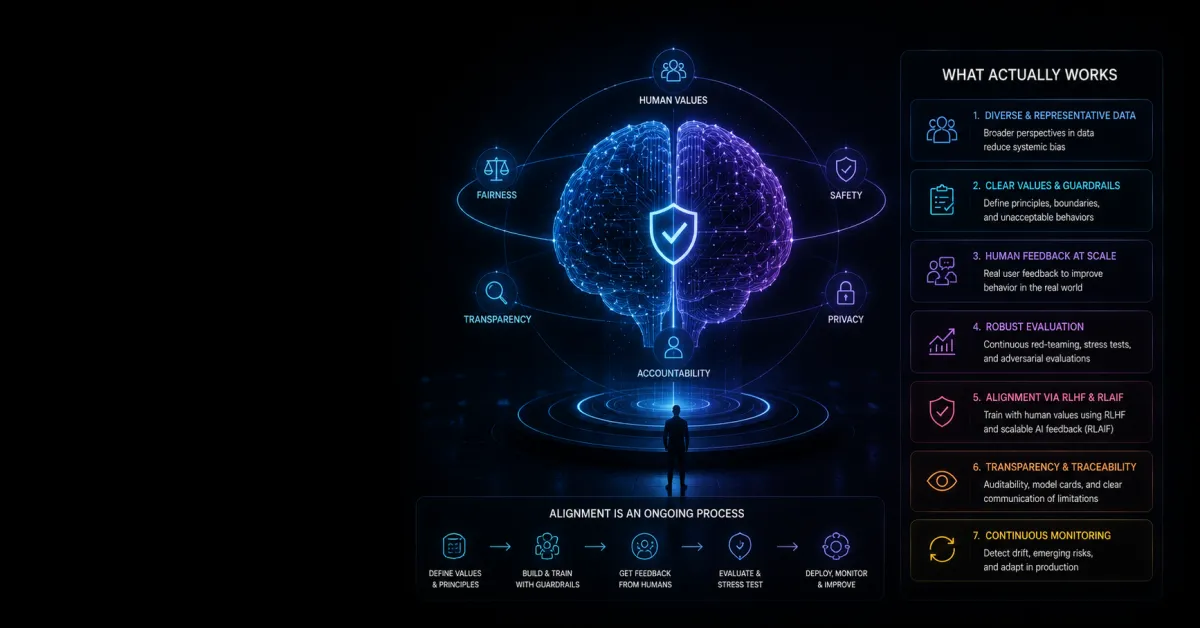
What Actually Works – Current Solutions
Constitutional AI and Value Alignment
Constitutional AI is one of the more promising approaches. Instead of trying to manually specify every desired behavior, you give the system a set of principles (a “constitution”) and have it critique and improve its own outputs against those principles. It’s not perfect, but it’s a step toward alignment that scales better than human feedback alone.
The idea is elegant: have the AI itself act as a quality filter based on a set of values you define upfront. Anthropic’s approach with Claude is the most visible example, though other labs are experimenting with similar frameworks.
Mechanistic Interpretability
If you can’t oversee what a system is doing, the next best thing is understanding how it actually works internally. Mechanistic interpretability – the field of reverse-engineering neural networks to understand their decision-making – is getting real results. Researchers have successfully identified specific neurons responsible for specific behaviors, which opens the door to targeted alignment interventions.
This is painstaking work. It’s like debugging code that was written by a process you don’t fully understand. But it’s one of the few approaches that could actually give us genuine understanding rather than just hoping for the best.
Red Teaming and Adversarial Testing
You find problems by actively looking for them. Red teaming – hiring people specifically to break your AI system and find misalignment – has become standard practice at major labs. It’s not foolproof, but it catches real issues before they hit production.
The limitation is that you can only test what you think to test for. Novel failure modes will still slip through. But it’s better than shipping untested.
Scalable Reward Modeling
Instead of manually specifying behavior, you can train a separate system to predict what humans actually want. This “reward model” then guides the main AI system. It’s not magic – the reward model itself can be misaligned – but it’s a practical approach that’s seeing real deployment.
Industry Standards and Governance
The AI safety space is moving from pure research into actual standards. The UK’s AI Bill of Rights, the EU AI Act, and various corporate commitments are starting to create real constraints on how frontier AI gets built and deployed.
Most responsible labs now have safety teams running in parallel with capability teams. There’s growing consensus that you need:
- Dedicated safety researchers separate from the team pushing for capability gains
- Pre-deployment red teaming and adversarial testing
- Ongoing monitoring after deployment
- Clear escalation procedures when problems are found
- Transparency reports on model capabilities and limitations
Is this enough? Probably not yet. But it’s the baseline that’s emerging as expected practice.
The Uncomfortable Truth
We don’t have a complete solution to AI alignment, and pretending otherwise is just wishful thinking. What we have are partial solutions that reduce risk but don’t eliminate it. Constitutional AI helps but isn’t bulletproof. Interpretability research advances understanding but can’t keep up with model complexity. Red teaming finds problems but can’t find all of them.
The honest take: we’re building increasingly powerful systems while our alignment techniques improve more slowly than capabilities do. That gap is the actual problem worth paying attention to. It’s why serious researchers are pushing hard on fundamental safety research rather than just adding more guardrails to existing systems.
FAQ – Real Questions About AI Safety
How do we know if an AI is actually aligned?
You don’t, not completely. You can test behavior in controlled environments, but alignment is contextual. An AI might be aligned in the lab and misaligned in the wild. This is why ongoing monitoring and red teaming matter – alignment is something you verify continuously, not once at deployment.
Can we just use more human feedback to align AI?
Not at scale. Humans can’t evaluate millions of outputs. This is the scalable oversight problem. You need automated methods, which brings you back to the specification problem. It’s turtles all the way down.
Are open-source AI models less safe than proprietary ones?
Different tradeoffs. Proprietary models have centralized control but less external scrutiny. Open models have more eyes on them but less control over deployment. Neither is automatically safer – it depends on implementation and the specific system.
What’s the difference between AI safety and AI ethics?
Safety is about preventing unintended harms – making sure the system does what you actually want. Ethics is about whether what you want is good. You can have a perfectly safe system that’s ethically problematic, and vice versa. Both matter.
How long until we solve alignment?
Nobody knows. It might be a solved problem in five years, or it might be an ongoing challenge we manage rather than fully solve. The pace of capability growth isn’t helping – we’re trying to hit a moving target.
Final Take
Frontier AI safety isn’t a problem that gets solved and then we move on. It’s a continuous challenge that gets harder as systems get more capable. The labs doing this seriously – building safety teams, running red teams, publishing transparency reports – are setting the bar. Everyone else is just hoping nothing breaks. The smart move is to pay attention to which organizations are actually investing in this versus which ones are just paying lip service.
If you’re tracking how AI development is actually happening versus the hype, this is the stuff that matters.