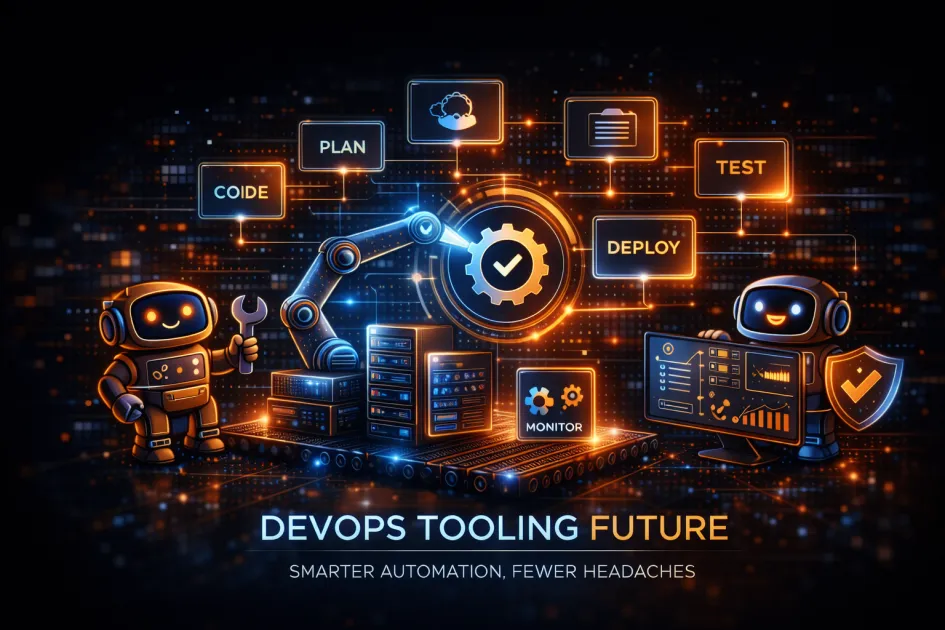
DevOps Automation | What’s Actually Changing?
DevOps tooling isn’t just about automating boring tasks anymore. It’s morphing into a nerve center powered by AI, predictive analytics, and self – healing systems – yes, your pipeline might soon fix itself before you even get your second coffee. Future trends in DevOps tooling and automation point to tools that not only automate but intelligently manage, optimize, and even secure your software delivery pipeline – without begging for constant hand – holding.
Here’s what’s really going on: the next wave of devops tools isn’t about adding more dashboards or yet another YAML file. It’s about platforms that anticipate breakages, surface root causes, and keep your cloud bill from spiraling into the stratosphere. Let’s cut through the hype and see what’s worth watching.
Key Terms (Because No One Likes Guessing)
- DevOps – The mashup of development and operations, focused on speeding up delivery and minimizing human error (good luck).
- Continuous Integration/Continuous Deployment (CI/CD) – The backbone of modern pipelines, automating the build, test, and deploy chain.
- Infrastructure as Code (IaC) – Managing servers and networks with code, not prayer.
- Observability – Going beyond logs and metrics to actually understand what your system is doing (or not doing).
- AI – Driven Automation – Letting machine learning spot trouble, optimize workloads, and sometimes, make things weirdly worse.
The Big Trends Shaping DevOps Tooling (2024 and Beyond)
AI Eats DevOps (And Your Job? Not Quite)
Let’s be honest – AI is elbowing its way into every DevOps tool in sight. But it’s not (yet) about replacing engineers. Instead, AI – powered automation now means:
- Predictive issue detection – Spotting anomalies before they take down your microservices. Think of it as having a cranky coworker who never sleeps.
- Intelligent resource optimization – Auto – tuning cloud resources, so you don’t wake up to a $10,000 AWS bill.
- Automated root cause analysis – No more sifting through 400 log files. The machine points out the bug, sometimes with passive – aggressive accuracy.
Tools like GitHub Copilot for DevOps, Harness, and GitLab’s AI integrations are leading this charge. But don’t expect miracles. You’ll still need humans to tell the difference between “smart automation” and “bad guesses.”
Self – Healing Infrastructure (Because Who Has Time for 2 AM PagerDuty Calls?)
Modern pipelines are heading into self – driving territory. Expect:
- Autonomous rollback and remediation – Pipelines that spot trouble and revert changes on their own.
- Policy – driven governance – Tools like HashiCorp Sentinel and Open Policy Agent enforce security and compliance without you writing 1,000 lines of bash scripts.
- Kubernetes Operators – Automate the management of complex workloads. Don’t worry, you’ll still need to Google half the error messages.
If you want a taste of this future, check out how some companies run “NoOps” cloud environments – where the machines are in charge (until they rebel).
Platform Engineering | The Return of the Golden Path
Here’s a shocker: teams are tired of wrangling a thousand tools. Enter platform engineering. Instead of chaos, you get:
- Internal Developer Platforms – Think Backstage or Humanitec, offering a paved road for shipping code, not a maze of YAML traps.
- Unified observability suites – Datadog, New Relic, and friends are gluing together metrics, traces, and logs, so you can actually find the needle in the haystack.
- Security baked – in – DevSecOps is not a buzzword when your CI/CD pipeline is actually scanning for vulnerabilities (and nagging you about it).
This trend is about making DevOps less about duct tape and more about real engineering. It’s not magic, but it beats running “kubectl get pods” for the hundredth time.
Low – Code, No – Code, and the Rise of Citizen Automation
Not every developer wants to be a YAML artisan. That’s why low – code and no – code tools are sneaking into the DevOps pipeline. Expect visual workflows, drag – and – drop integrations, and tools like Zapier or n8n connecting the dots with minimal code. It’s not replacing real engineering, but it gets the grunt work out of the way – most of the time.
Common Pain Points | The Future Isn’t All Unicorns
- Alert fatigue – Too many “critical” notifications, not enough coffee.
- Tool overload – If your team needs a spreadsheet to track tools, you’ve gone too far.
- Security gaps – Automation is only as smart as your last misconfigured rule.
- Opaque AI decisions – Ever tried arguing with an ML model? Good luck.
These aren’t going away. Smarter automation helps, but humans still need to tune, audit, and sometimes, unplug it all and start fresh.
How to Actually Prepare for the Next Wave of DevOps Automation
- Audit your pipeline – What’s manual? What breaks all the time?
- Pick tools that integrate, not isolate – The future is platforms, not silos. Look for open APIs and strong community support.
- Train your team – AI won’t save you if no one knows how it works. Upskill on cloud – native, security, and observability basics.
- Automate with intent – Don’t automate everything. Automate what’s boring, error – prone, or repeatable. Leave the weird edge cases for humans.
- Monitor and adapt – The best pipelines are living creatures. Change is constant, so revisit your setup quarterly – at minimum.
Comparing Modern DevOps Automation Tools
| Tool | Main Feature | AI Capabilities | Best For |
|---|---|---|---|
| GitHub Copilot | Code suggestions | Yes (ML – based) | Code automation |
| Datadog | Unified observability | AI – powered alerts | Monitoring |
| Terraform | IaC automation | Limited (for now) | Infrastructure |
| Harness | CI/CD automation | AI – driven pipelines | Continuous delivery |
| Backstage | Developer portals | Integration – focused | Platform engineering |
FAQ | DevOps Tooling, Automation, and the ‘Smart’ Future
Will AI take over DevOps jobs?
No. AI will automate grunt work and suggest fixes, but humans still need to design, review, and manage complex systems.
What’s the difference between automation and orchestration?
Automation handles individual tasks. Orchestration coordinates multiple automated tasks into workflows – think puppet master, not just puppets.
Are low – code DevOps tools worth it?
For routine tasks and fast prototyping – absolutely. For complex, mission – critical pipelines? Use with caution.
How can teams avoid tool overload?
Standardize on a core set of integrated tools. Avoid the temptation to chase every new shiny platform.
Is DevSecOps just hype?
If you like data breaches, skip it. Otherwise, integrating security early is non – negotiable – especially as automation increases attack surfaces.
Final Thought
DevOps automation is getting smarter, but it’s not a free ride. Pick tools that work for you, question every ‘AI – powered’ claim, and remember: the best pipeline is the one you barely notice – because it just works.