What’s the Point of Containers and Orchestration Anyway?
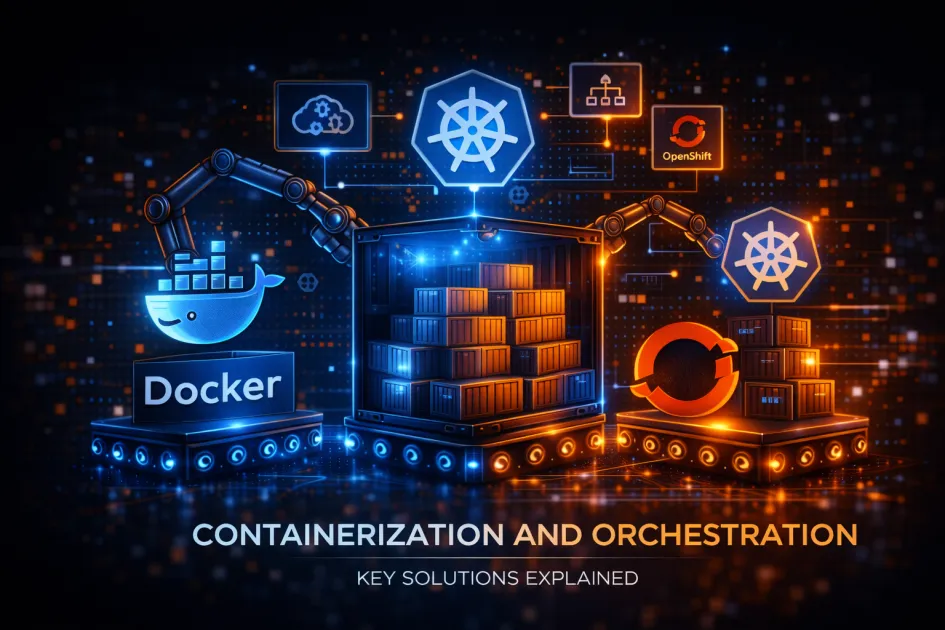
Ever tried herding cats? That’s what managing modern apps feels like – unless you use containerization and orchestration. These aren’t just tech buzzwords. Containerization is a method of packaging software and its dependencies into isolated units called containers, while orchestration automates their deployment, scaling, and management across clusters.
Together, they stop your apps from crashing and burning the moment your code leaves your laptop. If you’re tired of “it works on my machine” excuses or your microservices act like unsupervised toddlers, you’re in the right place.
Containerization – What It Is and Why Developers Actually Use It
Let’s keep it real: Containerization isn’t some magic spell. It’s a way to bundle your code, system libraries, and dependencies into a neat, portable box – the container. Think of it as a shipping container for your app: it runs the same way on your laptop as on the cloud. No more “dependency hell,” no more blaming the ops team for everything.
Key terms: Docker, images, runtimes, microservices, VMs (virtual machines), container registries.
- Docker is the poster child for containers – turning “works for me” into “works everywhere.”
- Images are the blueprints; containers are the running instances.
- Containers beat VMs in size and speed. No OS baggage, just your app and what it needs.
- Microservices? Containers make splitting up your monolith less painful.
Definition box:
Containerization is a method of packaging code and dependencies into isolated, lightweight units called containers, ensuring consistency across environments.
Orchestration – The Only Way Containers Don’t Become a Dumpster Fire
So you’ve got 200 containers running your microservices. Congrats. Now what? That’s where orchestration steps in. It’s the (grumpy) conductor that keeps your containers deployed, healthy, and scaled – without demanding overtime pay.
Primary orchestration tools: Kubernetes, Docker Swarm, OpenShift, Mesos.
- Kubernetes is the boss. It manages clusters, handles self-healing, scales up or down, and even rolls back updates when your “genius” code breaks things.
- Service discovery, load balancing, health checks – automated, not manual drudgery.
- Declarative configuration: describe what you want, let the system do it (unless you mess up the YAML).
Definition box:
Orchestration refers to the automation of deploying, scaling, and managing containers across clusters to ensure reliability and efficiency.
How It Works – The Workflow
- Write code, package it into a container image (with Docker or something similar).
- Push the image to a container registry (Docker Hub, AWS ECR, GitHub Container Registry – pick your poison).
- Orchestration tool (usually Kubernetes) pulls the image, spins up containers on available nodes.
- Traffic gets routed to the right containers with built-in load balancers.
- Orchestration monitors health, restarts crashed containers, and scales up/down based on demand.
It’s not rocket science, but it does beat the “deploy and pray” strategy.
| Feature | Containerization | Orchestration |
|---|---|---|
| What it does | Packages and isolates apps | Manages and automates containers |
| Main tool | Docker | Kubernetes |
| Key benefit | Consistency & portability | Scalability & reliability |
| Pain points | Complex configs, security risks | YAML headaches, steep learning curve |
Why This Actually Matters
- Portability: Run your stuff anywhere – on-premises, public cloud, multi-cloud, or some poor intern’s laptop.
- Efficiency: Containers are lightweight. Less overhead, faster boot times, no waiting for VMs to “wake up.”
- DevOps Dream: Automate CI/CD pipelines. Deploy updates without downtime. Roll back when things explode.
- Resource Utilization: Pack more apps onto your infrastructure. Stop wasting money on idle VMs.
- Security: Isolated environments mean fewer chances for one rogue process to take down your stack (unless you ignore security patches).
Common Problems (and How Not to Make Them Worse)
- YAML fatigue: Kubernetes loves YAML. You probably won’t. Use tools like Helm to avoid repetitive strain injury.
- Overengineering: Don’t containerize your “Hello World” script. Start with real microservices or apps that benefit from isolation.
- Monitoring mess: Once you go past a dozen containers, visibility turns into chaos. Use Prometheus, Grafana, or Datadog – just pick something and stick with it.
- Security holes: Don’t run containers as root. Scan your images. Update often. Please.
Best Practices That Won’t Make You Hate Life
- Keep images minimal. Alpine is your friend – unless you like bloated security risks.
- Automate builds and deployments. Manual steps are where mistakes hide.
- Version your images. “Latest” is not a version, it’s a recipe for disaster.
- Use namespaces and RBAC (Role-Based Access Control) in Kubernetes. Don’t give everyone admin rights.
- Monitor everything, but don’t drown in alerts. Tune your thresholds.
Popular Tools That Don’t Suck (Most of the Time)
- Docker: Still the default for building images and running containers locally.
- Kubernetes: The heavyweight champion for orchestration. Cloud-native, battle-tested, annoyingly complex.
- Helm: Kubernetes package manager. Because nobody likes writing the same YAML over and over.
- Podman: Like Docker, but daemonless and rootless. Security nerds love it.
- Rancher, OpenShift, AKS, GKE, EKS: Managed Kubernetes platforms. They hide some pain, but not all.
FAQ
Do I need containers for every app?
No. Monoliths running fine on a VM don’t need a container. Use containers when you need portability, scalability, or isolated environments.
Is Kubernetes overkill for small projects?
Usually, yes. It’s like renting a bulldozer to plant a flower. Try Docker Compose or even managed container services first.
Are containers secure?
Safer than running everything on bare metal, but not bulletproof. Update images, don’t run as root, and scan for vulnerabilities.
How do containers compare with virtual machines?
Containers are faster, lighter, and more portable. VMs offer stronger isolation but take more resources. Pick what fits your use case.
Can I use containers for data science workflows?
Absolutely. They keep your dependencies in check, and your models reproducible. See our guide on deploying R models with containers for real-world tips.
Final Thoughts – Don’t Believe the Hype, Use What Works
Containerization and orchestration solve real headaches, but they’re not silver bullets. Use them when they save time, not just to follow the herd.