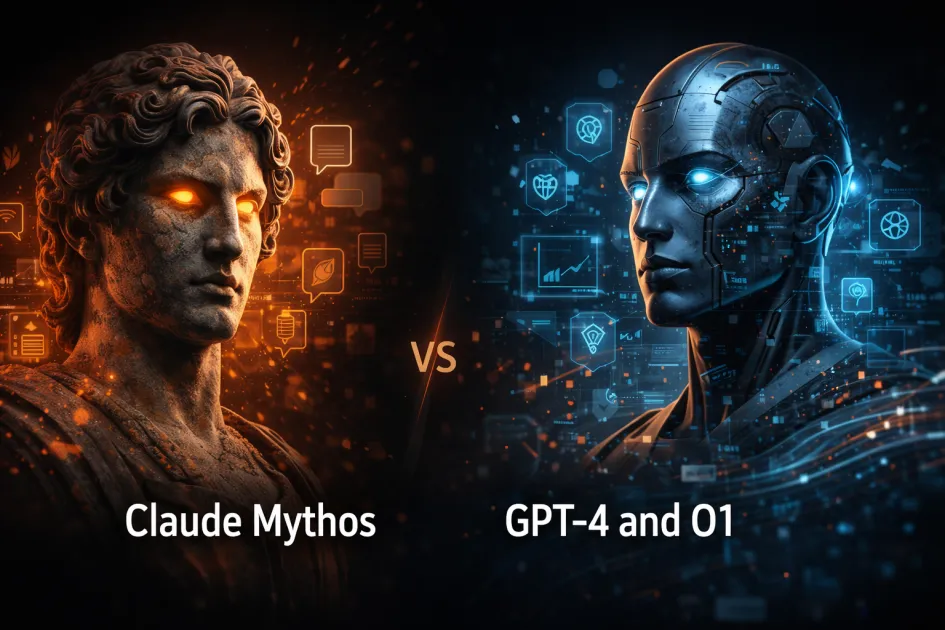
Claude Mythos vs. The Competition | What’s Actually Different
Claude Mythos is Anthropic’s latest large language model that claims to push reasoning capabilities and real-world performance beyond what Claude 3.5 Sonnet could do. But here’s the thing – comparing it to GPT-4, O1, and previous Claude versions requires looking past marketing speak and actually understanding where each model excels and where they stumble.
You’ve probably seen the headlines. Another AI model. Another “breakthrough.” Another reason to believe we’re one step closer to artificial general intelligence. But if you’re trying to figure out whether to use Claude Mythos for your actual work, or whether GPT-4 or O1 is still the better choice, you need the real story – not the press release version.
Let’s cut through the noise and talk about what these models actually do differently, where they genuinely matter, and where the differences are honestly just noise.
The Evolution – From Claude 1 to Mythos
Claude started as a capable but not groundbreaking model. Claude 2 added better reasoning. Claude 3 family (Opus, Sonnet, Haiku) introduced the tiered approach where you could pick your speed-vs-intelligence tradeoff. Claude 3.5 Sonnet became the model people actually used for serious work because it hit that sweet spot between being fast and being smart.
Then Claude Mythos showed up. Anthropic claims it’s their most capable model yet. The key improvements they’re highlighting include better long-context reasoning, improved performance on complex problem-solving, and stronger instruction-following. But “better” is vague. Let’s get specific.
Mythos handles longer documents without losing coherence – that’s real. It performs better on tasks requiring multi-step reasoning. It’s also more resistant to certain types of jailbreaks and prompt injection attacks, which matters if you care about safety (and you should). But these aren’t revolutionary changes. They’re incremental improvements on a foundation that was already solid.
Claude Mythos vs. GPT-4 – The Practical Differences
GPT-4 is still the heavyweight champion of general-purpose language models. It’s been battle-tested for longer, it has more real-world deployment experience, and OpenAI’s ecosystem (ChatGPT, API integrations, plugins) is more mature.
Where Claude Mythos pulls ahead: It’s genuinely better at nuanced writing tasks and creative work. The model seems to understand context and tone better. If you’re writing something that needs personality or emotional resonance, Mythos handles it with less awkwardness. It’s also faster at processing long documents without degrading quality.
Where GPT-4 still wins: It’s more reliable for highly specialized tasks like coding in obscure languages or handling very domain-specific jargon. GPT-4’s training data includes more niche technical content. It’s also more predictable – you know what you’re getting because millions of people have used it. The ecosystem is bigger, which means more integrations, more plugins, more tools built on top of it.
The honest take? If you’re already using GPT-4 and it works, there’s no urgent reason to switch. If you’re starting fresh and you do a lot of writing work, Mythos is worth testing. They’re close enough that your specific use case matters more than which model is “better.”
Claude Mythos vs. O1 – Different Animals Entirely
O1 is a completely different beast. It’s OpenAI’s reasoning-focused model designed specifically for complex problem-solving. It thinks through problems step-by-step before answering, which makes it slower but significantly more accurate on math, science, and logic-heavy tasks.
The key difference: O1 is a specialist. Claude Mythos is a generalist trying to be really good at everything. This changes everything about how you’d use them.
If you’re solving a physics problem, proving a mathematical theorem, or debugging complex code logic, O1 is your model. It’s built for that. It’ll take longer to respond, but the answer will be more reliable. Claude Mythos is faster and more conversational, but it won’t have O1’s reasoning depth on highly technical problems.
Think of it this way: O1 is like a mathematician who works slowly but gets the right answer. Claude Mythos is like a smart colleague who gives you a solid answer quickly and can explain it in plain English. You need the mathematician when precision matters. You need the colleague when you need something usable today.
Real-World Performance Comparison
Let’s look at where these models actually stand on tasks people care about:
| Task Type | Claude Mythos | GPT-4 | O1 |
|---|---|---|---|
| Long-form writing | Excellent | Very Good | Good |
| Code generation | Very Good | Excellent | Excellent |
| Complex reasoning | Good | Very Good | Excellent |
| Speed | Fast | Medium | Slow |
| Cost per token | Competitive | Higher | Highest |
| Context window | 1M tokens | 128K tokens | 128K tokens |
Notice something? There’s no clear winner. It depends entirely on what you’re doing. Mythos has the biggest context window, which is genuinely useful if you’re processing entire documents or codebases. GPT-4 is still the most reliable for production code. O1 is unmatched for reasoning-heavy work.
Why Context Window Actually Matters
Claude Mythos’s 1M token context window gets overlooked but it’s actually important. You can dump an entire book, codebase, or set of documents into it and the model maintains coherence throughout. GPT-4 and O1 max out at 128K tokens.
For practical work – analyzing large codebases, processing research papers, handling customer support conversations with full history – this matters. You don’t have to chunk your input into smaller pieces. You don’t lose context partway through. It’s a real advantage that doesn’t get enough attention because it’s not as flashy as “better reasoning.”
Safety and Alignment – Where Anthropic Has a Point
Anthropic built Claude Mythos with constitutional AI principles, which is their method for making models more aligned with human values. In practice, this means Mythos is less likely to produce harmful content and more resistant to jailbreak attempts. It’s also more transparent about its limitations and less likely to hallucinate.
GPT-4 has safety guardrails too, but they’re implemented differently. O1 was built with reasoning safety in mind – it’s harder to trick because it actually thinks through problems rather than pattern-matching.
If safety and reliability matter for your use case – and they should – Mythos has a legitimate edge here. It’s not just marketing. The model actually behaves more conservatively and admits uncertainty more often. Some people see this as a weakness. I see it as honest.
Cost and Accessibility
Claude Mythos pricing is competitive with GPT-4. Both are cheaper than O1. If you’re running high-volume operations, costs add up fast. Mythos’s efficiency – it gets good results without needing the extra reasoning steps that O1 requires – means lower bills for similar quality output.
Availability is worth considering too. Claude is available through Anthropic’s API and Claude.ai. GPT-4 is everywhere – ChatGPT, API, plugins, integrations. O1 is still limited to certain use cases and users. If you need something that works everywhere, GPT-4 still has the advantage. If you want the latest and greatest, Mythos is worth integrating.
Which Model Should You Actually Use
Use Claude Mythos if: You’re doing a lot of writing work, processing long documents, or building products where safety and alignment matter. It’s fast, handles context well, and produces surprisingly good output without needing to overthink everything.
Use GPT-4 if: You need the most proven, battle-tested model with the largest ecosystem of tools and integrations. It’s still the safest choice for production systems because it has the most real-world validation.
Use O1 if: You’re solving complex problems that require genuine reasoning – math, science, advanced debugging, research. Accept that it’ll be slower and more expensive, but you’ll get better answers.
Realistically? Most teams will use multiple models. You might use Mythos for customer-facing writing, GPT-4 for code, and O1 for your research team’s heavy lifting. The days of picking one model and sticking with it are over.
The Verdict
Claude Mythos is a solid model that represents real progress. It’s not a game-changer that makes everything else obsolete. It’s a good option that’s worth testing if you haven’t already. It might become your default model for certain tasks. It probably won’t replace everything you’re already using.
The AI landscape right now is less about “which model is best” and more about “which model is best for this specific thing.” Mythos is another excellent tool in the toolbox. That’s actually good news – it means you have real choices, and competition is pushing all these models to get better.
Common Questions About Claude Mythos
Is Claude Mythos actually better than Claude 3.5 Sonnet?
Yes, but not dramatically. It’s faster, handles longer contexts better, and produces slightly higher quality output. If you’re using Sonnet and it works for you, upgrading isn’t urgent. If you’re starting fresh, Mythos is the better choice.
Can Claude Mythos replace GPT-4 in production?
Depends on your specific use case. For writing-heavy work, yes. For code that needs to be bulletproof, probably not yet. Test it with your actual workload before committing.
Is O1 worth the extra cost?
Only if you’re doing work that genuinely requires complex reasoning. For general tasks, you’re paying for capability you don’t need. For research or advanced problem-solving, it’s worth every penny.
What about smaller models like Claude Haiku?
They still matter. Not everything needs a massive model. Haiku is cheap and fast for simple tasks. The trend is toward having multiple models for different purposes rather than one model for everything.
Will Claude Mythos be replaced in six months?
Probably. Anthropic releases updates regularly. But that doesn’t make Mythos obsolete – it just means the pace of improvement is fast. Whatever you build with it now will still work later, just like your GPT-4 code still works.
The takeaway? Stop waiting for the perfect model. Pick the one that fits your current needs, build something, and iterate. The models are good enough now. What matters is what you actually do with them.