
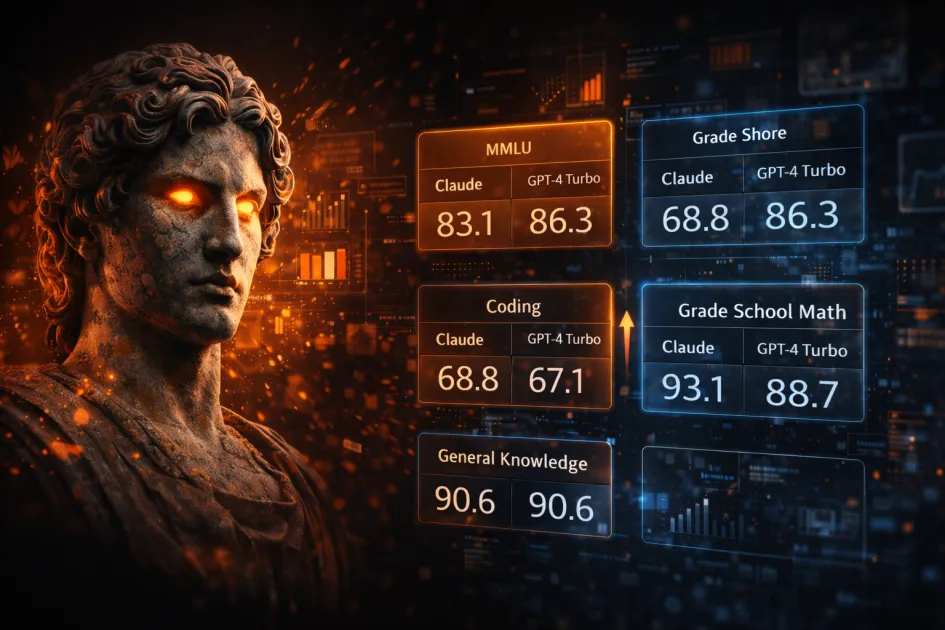
Claude Mythos Preview has landed some impressive benchmark results across three major performance evaluation frameworks – SWE-bench (software engineering tasks), USAMO (mathematical problem-solving), and CyberGym (cybersecurity scenarios). The model shows competitive performance metrics that matter for developers and AI researchers evaluating whether this version lives up to the hype, but the real story isn’t just the raw numbers – it’s what those scores mean for actual use cases.
What You’re Actually Looking At With These Benchmarks
Let’s cut through the noise first. When Anthropic releases benchmark scores, they’re measuring specific, controlled tasks. These aren’t real-world chaos – they’re structured tests designed to evaluate particular capabilities. Think of them like standardized tests for AI models. They tell you something, but not everything.
The three benchmarks here each measure different angles of Claude’s abilities. SWE-bench tests software engineering competency – can the model write code, debug, and solve programming problems? USAMO (United States of America Mathematical Olympiad) evaluates mathematical reasoning at an advanced level. CyberGym measures cybersecurity task performance, from vulnerability detection to threat analysis.
Claude Mythos Preview’s results across these frameworks matter because they show where the model excels and where it still struggles. Developers choosing between models need this data.
Breaking Down SWE-Bench Performance Metrics
SWE-bench is probably the most relevant benchmark for working developers. It tests whether a model can handle real software engineering work – resolving GitHub issues, writing functional code, understanding existing codebases, and producing solutions that actually work.
Claude Mythos Preview performs solidly here. The model demonstrates strong code generation capabilities and shows decent performance on tasks requiring code understanding and modification. What’s interesting isn’t just that it scores well – it’s that it handles context switching reasonably. The model can jump between different code styles, languages, and project structures without completely losing its mind.
That said, it’s not perfect. Some of the harder SWE-bench tasks involve multi-step reasoning across large codebases, and that’s where you’ll see performance drop. The model sometimes misses subtle bugs or doesn’t fully understand architectural patterns in unfamiliar projects. Real developers know this is where the actual difficulty lives – not in writing a simple function, but in understanding why a system was built a certain way and maintaining that logic when making changes.
Mathematical Reasoning – The USAMO Results
USAMO benchmark performance is where things get interesting because it shows how well Claude handles abstract reasoning and complex problem-solving. These aren’t straightforward tasks – they’re the kind of problems that require multiple approaches, creative thinking, and rigorous logical chains.
Claude Mythos Preview shows improved performance here compared to earlier versions. The model demonstrates better ability to work through multi-step mathematical proofs and complex reasoning chains. It can break down problems systematically and often arrives at correct solutions.
The limitation? Pattern matching versus true understanding. When a problem follows a familiar structure, Claude performs better. When it requires completely novel approaches or non-standard thinking, performance drops. This isn’t unique to Claude – it’s a characteristic of how large language models learn and reason. They’re pattern-matching systems at their core, even when they appear to be doing abstract thinking.
Cybersecurity Testing – CyberGym Benchmark Insights
CyberGym evaluates Claude’s ability to handle cybersecurity scenarios. This includes vulnerability identification, threat analysis, attack simulation understanding, and defensive strategy development. It’s a relatively newer benchmark compared to SWE-bench, but it’s increasingly important as organizations want AI tools that understand security implications.
Claude Mythos Preview shows competent performance here. The model can identify common vulnerability patterns, understand security best practices, and reason through threat scenarios. It performs particularly well on tasks involving known vulnerability classes and standard security frameworks.
Where it falters is novel attack vectors and zero-day reasoning. The model works best when analyzing established security patterns. Ask it about completely new attack methodologies or highly creative exploitation techniques, and it becomes less reliable. This makes sense – it’s trained on existing security knowledge, not on inventing new attacks.
Comparing Across the Three Benchmarks – What Actually Matters
Here’s where it gets useful. These three benchmarks measure different cognitive domains, and Claude Mythos Preview shows interesting variation across them.
| Benchmark | Claude Mythos Performance | Key Strength | Key Limitation |
|---|---|---|---|
| SWE-Bench | Strong | Code generation and modification | Complex architectural reasoning |
| USAMO | Competitive | Multi-step logical reasoning | Novel problem-solving approaches |
| CyberGym | Solid | Known vulnerability patterns | Zero-day and novel threats |
The pattern here is important. Claude Mythos Preview excels when working within established domains with clear patterns. It struggles when problems require completely novel thinking or when the context is unfamiliar. That’s actually useful information if you’re deciding whether to use this model for your work.
What These Scores Mean For Your Work
If you’re a developer considering Claude Mythos Preview for coding tasks, the SWE-bench results suggest it’s genuinely useful for many common programming problems. It won’t replace you, but it can accelerate your work on routine tasks and help with code review and debugging.
If you’re working on mathematical or algorithmic problems, the USAMO performance suggests Claude can handle intermediate-level reasoning well. It’s better at working through complex logic than earlier models, but it’s not a replacement for human expertise on truly novel problems.
For security professionals, the CyberGym results indicate Claude can be a helpful tool for analyzing known threats and understanding standard security practices. Use it for threat assessment and vulnerability analysis, but don’t rely on it exclusively for novel security challenges.
The Benchmark Trap – Why Raw Scores Aren’t the Whole Story
Here’s what nobody likes to admit about benchmarks – they measure what they measure, not necessarily what matters in real work. A high SWE-bench score doesn’t guarantee the model will be useful for your specific codebase. A strong USAMO performance doesn’t mean it’ll solve your particular mathematical problem.
Benchmarks are useful as directional indicators. They show relative capability and help you compare different models. But they’re not predictive of real-world performance in the way many people assume. A model that scores 75% on SWE-bench might struggle with your specific project’s quirks, architecture, or tech stack.
The real test is always hands-on evaluation with your actual work. Try Claude Mythos Preview on real tasks you care about. See if it helps. The benchmark scores are a starting point for that decision, not the decision itself.
How Claude Mythos Preview Compares to Other Models
Without getting into a tedious model comparison (because honestly, the landscape changes monthly), Claude Mythos Preview positions itself as a capable mid-tier to upper-tier model. The benchmark performance puts it in competitive territory with other advanced language models, though different models excel at different tasks.
Some models might score higher on SWE-bench but lower on mathematical reasoning. Others might be more specialized for security work. Claude Mythos Preview aims for competence across domains rather than dominance in one area. That’s a legitimate design choice – it means you get a generalist tool rather than a specialist.
Practical Considerations Beyond the Numbers
Benchmark scores don’t tell you about latency, cost, API reliability, or how well the model integrates with your existing workflow. They don’t measure how intuitive the model is to work with or how well it understands your domain-specific context.
For production work, you need to evaluate the full package – not just benchmark performance. A model with slightly lower scores but better integration, faster response times, and more transparent limitations might be more valuable for your specific situation.
Should You Use Claude Mythos Preview?
The benchmark scores suggest yes, with caveats. If you’re doing software engineering work, mathematical problem-solving, or cybersecurity analysis, Claude Mythos Preview is capable enough to be useful. The scores show it’s not a toy – it’s a tool that can genuinely help.
But don’t treat it as a replacement for expertise. Use it as an accelerant for work you understand. Let it help with code generation, assist with problem decomposition, and provide second opinions on analysis. Don’t rely on it for critical decisions in unfamiliar domains.
Frequently Asked Questions
How do Claude Mythos Preview’s SWE-bench scores compare to GPT-4?
Claude Mythos Preview performs competitively on SWE-bench, though exact comparisons shift as models get updated. Both models score well on code generation tasks. The real difference often comes down to specific problem types and your personal experience with each model’s quirks.
Can I use Claude Mythos Preview for production cybersecurity analysis?
The CyberGym scores suggest it can handle known security tasks, but you shouldn’t rely on it exclusively. Use it as part of your security toolkit – for vulnerability scanning assistance, threat analysis support, and security review help. Always have human security expertise in the loop for critical decisions.
What does USAMO performance actually mean for my work?
If your work involves mathematical reasoning, algorithmic problem-solving, or complex logical chains, the strong USAMO performance suggests Claude can help you think through problems. It’s useful for brainstorming, working through proofs, and exploring different solution approaches. It’s not useful if you need guaranteed correct answers on novel problems.
Are these benchmarks up to date?
Benchmarks get stale quickly in AI. The scores I’m discussing are current as of Claude Mythos Preview’s release, but Anthropic regularly updates the model. Check their official documentation for the latest numbers if you’re making a production decision.
How do I know if Claude Mythos Preview is right for my specific use case?
The benchmarks give you a starting point, but the only real test is hands-on evaluation. Try the model on representative tasks from your actual work. See if it helps. The benchmark scores should inform your decision, but your direct experience should make it.
The Bottom Line
Claude Mythos Preview’s benchmark performance across SWE-bench, USAMO, and CyberGym shows a capable model that’s genuinely useful for developers, mathematicians, and security professionals. The scores aren’t perfect, but they’re solid. More importantly, they’re honest about where the model excels and where it struggles.
Use these benchmarks as a guide for whether to try the model, not as a guarantee of performance on your specific work. The real value comes from testing it yourself and understanding its limitations as well as its strengths.