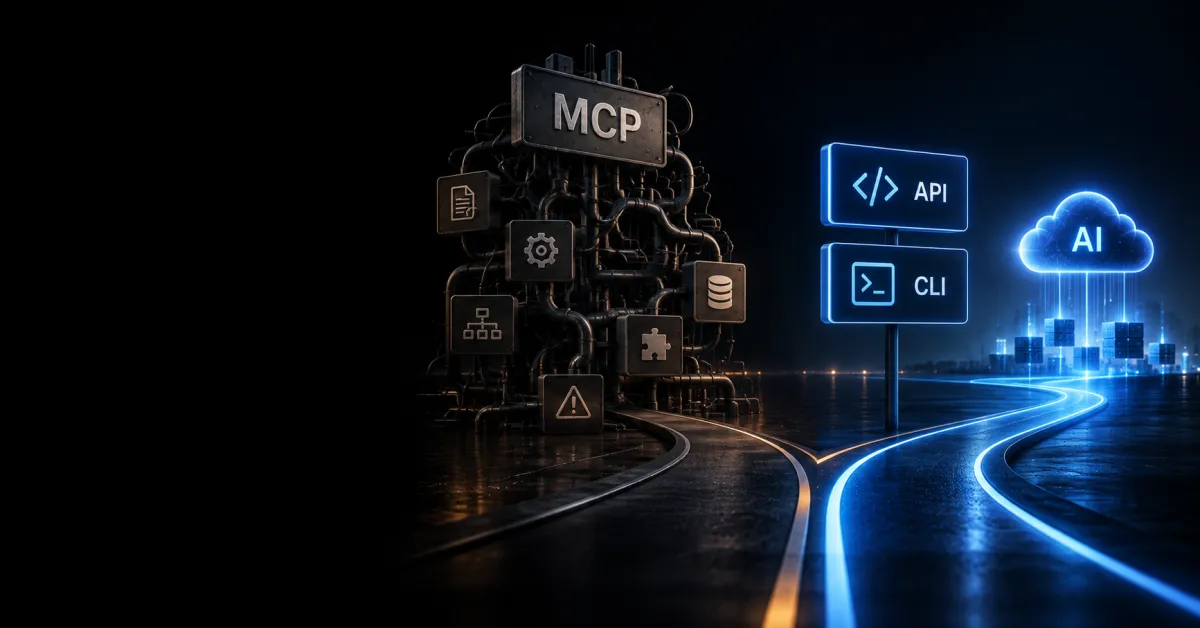
Everyone and their cousin is suddenly obsessed with Model Context Protocol (MCP) as the silver bullet for AI integrations. It’s the new hotness. The framework everyone’s supposed to use. But here’s the thing – MCP isn’t always the right tool, and pretending otherwise is how you end up with overcomplicated serverless functions that take twice as long to debug.
Building serverless AI integrations without MCP is often the smarter move. Direct API calls and command-line interfaces can be faster, simpler, and more maintainable than forcing your architecture into a protocol designed for something different. Sometimes the straightforward path beats the trendy one.
Why Everyone’s Suddenly Talking About MCP
Model Context Protocol emerged as a way to standardize how AI models interact with external tools and data sources. It’s a legitimate solution for specific problems – mainly when you need a unified interface between multiple LLMs and various backend systems. Anthropic built it, developers got excited, and now it feels like the default answer to every AI integration question.
The problem? It’s not always the answer. MCP adds abstraction layers, requires additional tooling, and introduces another moving part that can break. For simpler serverless scenarios, you’re often just adding complexity without real benefits.
When Direct API Calls Actually Win
Let’s talk about what actually matters for most serverless AI workflows. You’re probably running functions on AWS Lambda, Google Cloud Functions, or Azure Functions. You need to call an AI API – maybe OpenAI, Anthropic, or a local model. You want to fetch some data, process it, and return results. That’s it.
Direct API calls handle this in roughly 20 lines of code. No protocol overhead. No additional dependencies. Just your serverless runtime, the HTTP client it already has built in, and the endpoints you’re calling. The latency is lower because you’re not routing through extra middleware. Debugging is easier because the error stack is shorter. Costs are lower because you’re not spinning up additional services.
This approach works beautifully when your integration needs are straightforward – calling an LLM, retrieving structured data, transforming it, and returning a response. The fewer moving parts, the fewer things that fail in production at 2 AM.
CLI Tools for Orchestration Without the Overhead
Here’s where CLI-based approaches shine. Instead of building everything inside your serverless function, you can orchestrate workflows using command-line tools. Tools like jq, curl, and language-specific CLIs let you chain operations together without writing a full application.
A serverless function can invoke CLI commands to handle specific tasks – preprocessing data, calling external services, or transforming outputs. This keeps your function code lean and testable. You can iterate on the CLI logic locally before deploying it. You can version it independently. You can reuse it across different functions.
The beauty here is separation of concerns. Your function handles the serverless-specific logic – event handling, authentication, response formatting. The CLI handles the actual work. They’re decoupled, which means changes to one don’t break the other.
Building Your Stack Without MCP
Start with what you actually need. Do you have a single AI model you’re calling? Direct API call. Do you need to orchestrate multiple steps? Chain CLI tools or use a simple orchestration library. Do you need to support multiple AI providers? Build a thin abstraction layer – not MCP, just a simple interface that maps to your specific use cases.
The architecture looks like this – your serverless function receives an event, parses it, makes one or more API calls to AI services or data sources, processes the response, and returns the result. No protocol layer sitting between you and the actual work. No extra tooling to maintain. Just clean, focused code that does one thing well.
For data pipelines, combine serverless functions with CLI tools. A function triggers, runs a preprocessing script, calls an API, runs a transformation script, stores results. Each piece is testable independently. Each piece is replaceable without touching the others.
Real Trade-offs to Consider
Scalability matters. If you’re building something that needs to support dozens of different AI models and hundreds of different integrations, MCP’s standardization actually becomes valuable. But most projects aren’t there. Most projects have 2-3 AI providers and a handful of integrations.
Team size and experience matter. If your team already knows MCP and has standardized on it, forcing everyone to learn a different approach creates friction. But if you’re starting fresh, the simpler path is usually the right one.
Debugging and monitoring are easier with direct calls. You can see exactly what’s happening at each step. Error messages are clearer. Stack traces are shorter. You spend less time figuring out where things broke.
The hidden cost of MCP for simple use cases is cognitive load. Your team has to understand the protocol, the tooling, the abstraction layers. New developers need onboarding. Bugs become harder to trace because there’s more indirection. For straightforward integrations, this cost outweighs any benefits.
Practical Example – Building a Simple AI Integration
Let’s say you’re building a serverless function that takes user input, sends it to Claude, and returns the response. With direct API calls, you’re looking at this flow – receive event, extract text, call Anthropic API with your key, parse response, return result. Maybe 30 lines of code in Python or Node.js.
Add CLI orchestration if you need preprocessing. Your function calls a shell script that cleans the input, validates it, and pipes it to jq for formatting. Then the function makes the API call. Then it calls another script to format the output. Three focused pieces that work together without coupling.
With MCP, you’d set up the protocol, define your tools, configure the server, integrate the client, and handle all the abstraction mapping. You’d have more code, more dependencies, and more things that could break. For this simple case, you’re solving problems you don’t have.
When You Should Actually Use MCP
MCP makes sense when you’re building a complex AI agent that needs to interact with multiple external systems consistently. When you need a standardized way for different LLMs to access the same tools. When your integration requirements are genuinely complex and benefit from standardization.
It also makes sense if you’re building infrastructure that other teams will use. If you’re creating a platform for AI integrations, standardizing on MCP gives you consistency. But if you’re building a specific feature for a specific product, you probably don’t need it.
The key question – are you solving a problem MCP actually addresses, or are you using it because it’s trendy? If you can’t clearly articulate why MCP solves your problem better than direct API calls, you probably don’t need it.
FAQ
Is using direct API calls less “professional” than MCP?
No. Professional means shipping working code that your team can maintain. If direct API calls do that with less complexity, that’s the professional choice. Trendy doesn’t equal professional.
Will direct API calls limit my ability to scale later?
Not really. Refactoring direct API calls into a more structured approach is straightforward. You’re not locked in. But over-engineering for scale you don’t have yet creates problems now.
Can I mix direct API calls with CLI tools in the same function?
Absolutely. That’s actually a solid pattern. Use direct calls for the main logic, CLI tools for specific tasks. They work well together.
What about error handling and retries without MCP?
Handle it in your function. Most serverless platforms have built-in retry mechanisms. Your function code can implement exponential backoff. You don’t need a protocol layer for this.
If I start with direct calls, can I migrate to MCP later?
Yes, but you probably won’t need to. Most projects that start simple stay simple. And that’s fine. Complexity should be added when it solves real problems, not preemptively.
In Closing
The serverless AI integration that wins is the one you ship, maintain, and debug easily. MCP is a tool with legitimate use cases, but it’s not the default answer. Start with direct API calls and CLI orchestration. Build what you need, nothing more. If complexity becomes a real problem later, you can always add structure then. Spoiler alert – it usually doesn’t.