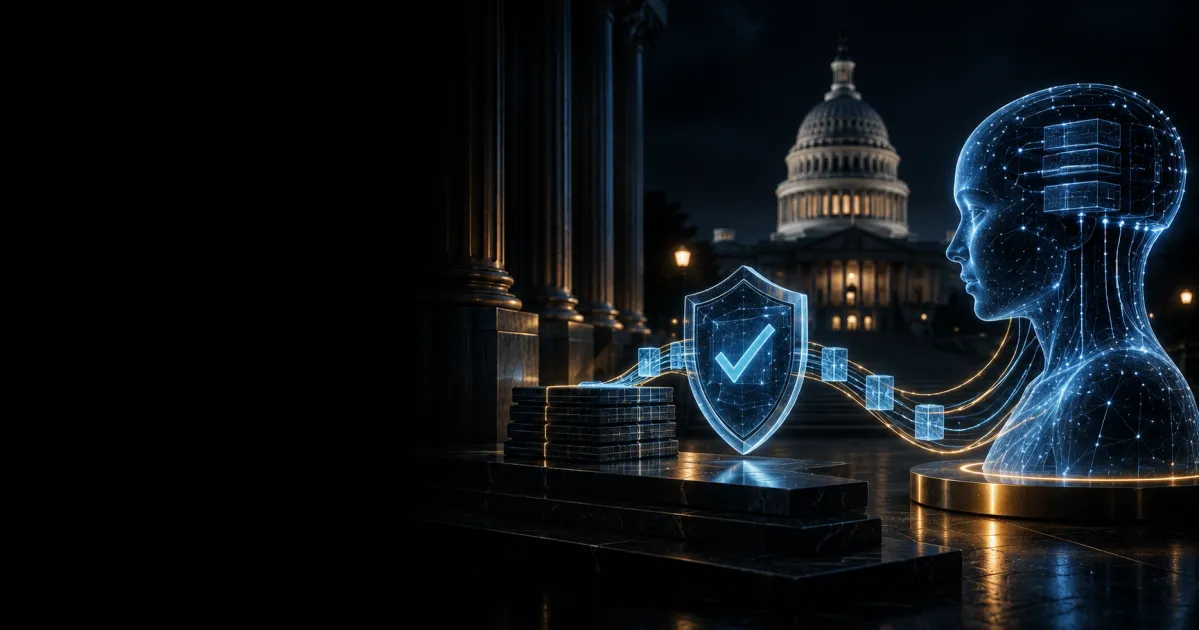
Congress is finally getting serious about AI regulation, and they’re not messing around. After years of tech executives dodging hard questions, lawmakers are pushing for real verification mechanisms to ensure AI systems actually do what companies claim they do. Enter Proof-of-Control v1.0 – a technical framework designed to bridge the gap between what AI companies promise and what they can actually prove.
Proof-of-Control v1.0 is a verification protocol that allows organizations to demonstrate they maintain meaningful oversight and control over their AI systems’ outputs and behavior. It’s essentially a standardized way to prove to Congress and regulators that you’re not just hoping your AI behaves responsibly – you’ve built mechanisms to enforce it. Think of it as the difference between saying “trust us” and showing actual evidence of governance.
Why Congress Suddenly Cares About AI Verification
Here’s the thing – legislators realized that asking AI companies whether their systems are safe is about as effective as asking a teenager if they’ve been sneaking out. You need actual proof. The bipartisan AI legislation emerging from Capitol Hill reflects a growing consensus that self-regulation has failed spectacularly, and there’s real political will to establish baseline requirements.
The problem is straightforward. Large language models and generative AI systems are black boxes. Even their creators can’t fully explain why they make specific decisions. So when OpenAI says ChatGPT won’t help with illegal activities, or when Anthropic claims Claude is “constitutional,” regulators have no way to independently verify those claims. It’s all trust-based, which obviously doesn’t work at scale.
Bipartisan legislation like the proposed AI Liability Framework and various Senate bills are pushing for concrete accountability measures. They want technical standards, not just policy promises. Proof-of-Control v1.0 fills that gap by providing a framework that actually demonstrates control rather than just asserting it.
What Proof-of-Control v1.0 Actually Does
The framework operates on a straightforward principle – if you claim to control something, you should be able to prove it through measurable mechanisms. For AI systems, this means documenting and demonstrating several key capabilities.
Monitoring and Detection Systems
First, you need to show you’re actually watching your AI system’s behavior in real-time. This isn’t theoretical monitoring – it means logging outputs, tracking edge cases, and maintaining audit trails. If your system generates harmful content, you need to prove you detected it and know how it happened.
Intervention Capabilities
Second, you need demonstrated ability to intervene when things go wrong. Can you shut down a model? Retrain it? Update its parameters? Roll back to a previous version? Proof-of-Control requires you to document these mechanisms and show they actually work, not just that they theoretically exist in your infrastructure.
Traceability and Documentation
Third, everything needs to be traceable. Training data sources, fine-tuning processes, safety testing results, failure modes discovered during testing – all of it needs documentation that regulators can actually review. This is where most AI companies currently fall apart. Many don’t maintain comprehensive records of their own development processes.
How Bipartisan Legislation Uses Proof-of-Control
The congressional push for AI regulation isn’t some theoretical exercise. Real bills are being drafted with verification requirements built in. Proof-of-Control v1.0 serves as a technical standard that addresses what regulators actually need to assess compliance.
Bipartisan bills typically include provisions requiring AI developers to demonstrate control over high-risk systems. This isn’t about banning AI – it’s about creating accountability structures. Companies can still build and deploy systems, but they need to prove they’ve implemented reasonable safeguards and monitoring.
The verification process would likely involve third-party audits where independent evaluators assess whether a company’s claimed control mechanisms actually exist and function as described. Think of it like SOC 2 compliance for AI – a standardized audit framework that proves you’ve implemented what you said you implemented.
The Technical Reality vs. Political Expectations
Here’s where things get messy. Congress wants verification standards. Technical experts know that proving control over a large language model is genuinely difficult. The disconnect between what regulators want and what’s technically feasible creates real implementation challenges.
You can monitor outputs. You can document training processes. You can show audit trails. But can you truly prove you control a system’s behavior at a fundamental level? That’s harder. Large models exhibit emergent behaviors – capabilities that weren’t explicitly trained but appear anyway. Proving you control those is like proving you control a complex ecosystem.
That’s not an excuse for inaction, though. Proof-of-Control v1.0 represents a pragmatic middle ground – it establishes what you can reasonably demonstrate and measure, then creates accountability based on those measurable factors. It’s not perfect verification, but it’s infinitely better than “we promise to be careful.”
What Companies Need to Do Now
If you’re building AI systems, you should assume verification requirements are coming. Here’s what that means practically.
- Document everything. Your training data sources, model versions, fine-tuning processes, safety testing results, failure cases discovered during development – all of it needs comprehensive documentation. Start now, because retrofitting documentation is painful.
- Implement monitoring systems. You need real-time visibility into your model’s behavior in production. This means logging outputs at scale, not just spot-checking results.
- Build intervention capabilities. Ensure you can actually modify, update, or roll back your systems. Don’t just assume you can – test it.
- Conduct third-party testing. Get external experts to evaluate your safety claims. Internal testing is necessary but not sufficient for regulatory credibility.
- Establish governance structures. Create actual oversight mechanisms – review boards, safety teams, escalation procedures. These need to be real, not just org chart entries.
Real Questions About Implementation
Will Proof-of-Control v1.0 Actually Stop Bad AI?
Probably not completely. It’s a verification framework, not a safety guarantee. It proves you’ve implemented control mechanisms, not that those mechanisms prevent every possible harm. Think of it like food safety regulations – they don’t guarantee you’ll never get sick, but they significantly reduce risk through standardized practices.
Does This Give Smaller Companies a Disadvantage?
Potentially, yes. Implementing comprehensive monitoring and documentation systems requires resources. Larger companies with established infrastructure will find compliance easier than startups. This is a legitimate concern, and regulators will need to consider scaling requirements based on model size and risk level.
How Do You Verify Control Over Open-Source Models?
This is the hard one. If you release a model to the public, you lose direct control. Proof-of-Control v1.0 would likely focus on what you can demonstrate – your own safety testing, your intended use cases, the safeguards you built in. But once it’s open source, responsibility becomes distributed and harder to verify.
Will This Slow Down AI Development?
It will add compliance overhead, sure. But “moving fast and breaking things” has already broken public trust in AI companies. Some friction in the development process might actually be healthy. The question isn’t whether verification adds time – it’s whether that time is worth the accountability we get in return.
What Happens If Companies Can’t Meet Verification Standards?
That’s where enforcement comes in. Real legislation would include penalties – fines, deployment restrictions, or loss of government contracts. The threat of actual consequences is what makes regulatory frameworks work. Right now, AI regulation is toothless because there are no real consequences for non-compliance.
In Closing
Proof-of-Control v1.0 and the bipartisan push for AI verification represent a shift from hoping companies self-regulate to actually requiring them to prove they’re doing it. It’s not a perfect solution, but it’s a necessary one. Congress is finally asking the right question – not “should we regulate AI?” but “how do we verify that AI companies are doing what they claim?” That’s progress.